
What 23,000 Shopify Chatbot Conversations Taught Us About Shopper Intent
 Frederick Casey Housand - May 7, 2026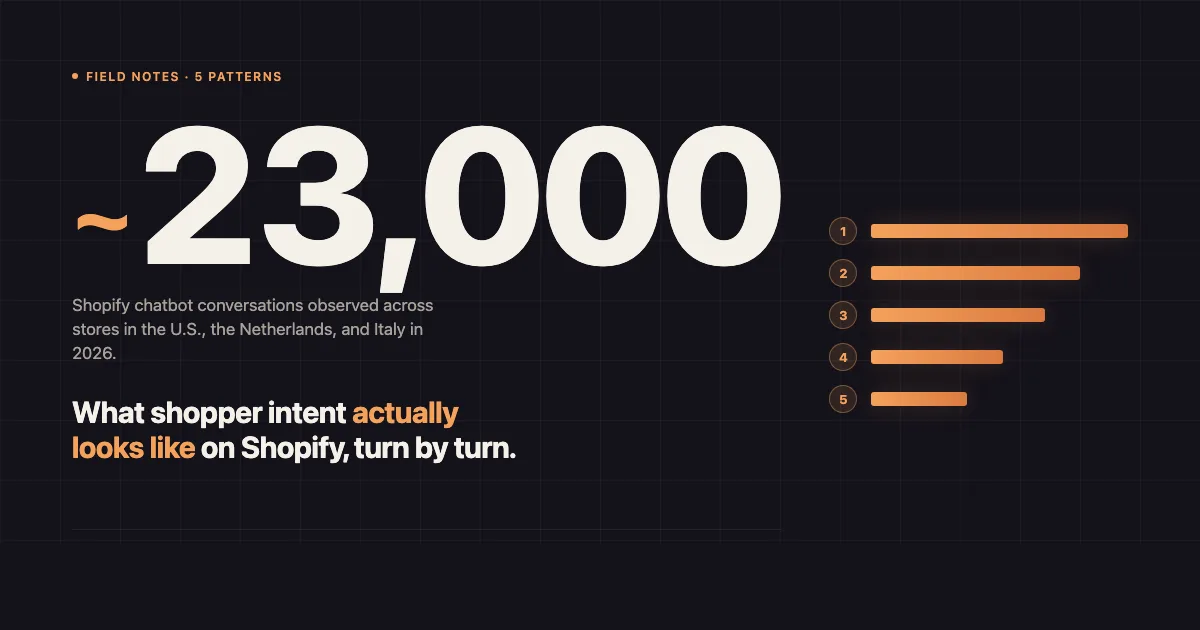
Shopify chatbot shopper intent is rarely one question. It is a sequence of three to five turns that drifts from availability to fit to objection, often crossing languages, and the patterns are now consistent enough across stores to publish.
Last quarter at a Bay Area sporting-goods store, I watched a shopper ask a chatbot whether a specific bike rack was in stock at the San Francisco location. Three turns later she was asking whether the rack would survive a winter in Tahoe and whether the store would price-match REI. The bot answered turn one in English; turns two and three came back in literal-translation Spanish because she had switched mid-session. The store’s previous chatbot would have answered turn one and dropped the rest.
That conversation is the entire reason this post exists. After watching the same session shape repeat across stores in the U.S., the Netherlands, and Italy on roughly 23,000 conversations in 2026, five patterns are stable enough to write down. Most “Shopify chatbot best practices” guides describe what shoppers should ask. This one names what they actually ask. For the buyer-side framing of where a chatbot fits in a Shopify stack, the broader chatbot pillar is the place to start.
Shoppers ask about availability before they ask about features
Read most “Shopify chatbot best practices” advice and you would think the first turn of every conversation is a feature question. It is not. Across Apparel, Home & Garden, and Beauty stores (which together account for more than half of the customer base we observe), turn one is almost always an availability question. Stock. Size. Pickup window. Color in this size at this store. Feature questions are turn three, not turn one.
The Bay Area sporting-goods example is not unusual. The opening question was about whether a specific item was in stock at a specific store, and only after that did the shopper start asking whether it would do the job. That sequence holds across verticals. Apparel shoppers ask about size availability before fabric. Home & Garden shoppers ask about delivery window before assembly. Beauty shoppers ask about shade availability before ingredients.
This is uncomfortable for any vendor that built around an FAQ replacement. A chatbot that opens with “What can I help you find today?” and routes through a feature taxonomy misses the first move. The shopper is not asking what the product does. The shopper is asking whether the product is available to them, where they are, in the variant they want. That is a live-inventory question, and the assistant-versus-chatbot distinction starts here: an assistant surfaces availability proactively, a chatbot waits to be asked.
The take: feature-first chatbot design is built around the wrong opening turn. Availability is the opening turn. Treat features as the third move, after the shopper has already confirmed the item exists in their world.
Multi-turn refinement collapses on the third question
The second pattern is the drop-off shape. Turn one is broad. Turn two narrows. Turn three either converts or collapses. The third question is the one most chatbots are not designed for, and it is also the one most likely to convert when answered well.
We have watched this play out enough times to map it. The bot handles turn one because turn one is generic (“Do you have this in stock?”). The bot handles turn two because turn two is a logical narrowing (“In medium?”). The bot fails turn three because turn three reaches into context it did not load on turn one. The shopper does not re-explain. The shopper drops the session. At Puffo Sport in Italy, a recurring observation is that customers mistake the bot for a human, which is a trust signal. When a bot has earned that level of trust, a missed turn-three answer reads as the store not knowing the answer, and the shopper closes the tab. The fix is structural. The chatbot’s third-turn answer needs to draw on the same source the first two turns drew on, plus whatever the shopper introduced in turns two and three. The reason most bots fail it is that they are stitched from a chat layer over a search index that did not see turn two. The pattern that holds turn three together is answer-first content architecture , and it is the underrated lever in this whole stack. For the system-mechanics view of why that third turn is structurally hard, the question types, the per-turn latency budget, and the split between retrieval and reasoning, see the anatomy of a Shopify chatbot conversation .
The take: turn three is where conversion lives. A chatbot designed to handle the first two turns is a chatbot that politely loses sales on the third.
Shoppers switch languages mid-session more often than they finish in one
Language switching is not an edge case in international Shopify stores. It is the dominant pattern. The bot’s first-turn language is rarely the session’s final language, and the customer rarely apologizes for the switch.
The customer base we observe skews international. The U.S. is the largest single country (about a third of installs), but the Netherlands, U.K., and Germany together account for another 30%. The 23+ language stack with automatic detection exists because of what those stores see in their conversation logs, not the other way around. At IPcam-shop in the Netherlands, a typical session starts in Dutch when the shopper lands on a product page in their browser locale, jumps to English for a technical clarification because the spec sheet is in English, and ends in Dutch again when the shopper is ready to commit. It is what bilingual shoppers have always done, and they expect the bot to follow without asking them to repeat themselves.
There is a real-time signal underneath this too. Last week, the French query “meilleur chatbot ia pour boutique shopify en 2026” surfaced for the first time in our search-impression data at 45 impressions and a position in the top 6. That is cross-language demand showing up in the SERP, not just in the chat logs. The deeper play is in multilingual chatbot architecture for Shopify , which gets into where translate-API passthrough breaks down on a real product catalog.
The take: marketed “100+ languages” is the wrong number to optimize for. The right number is how many languages a bot can carry inside the same session without losing the intent thread.
Post-purchase questions leak back into pre-purchase intent
Most chatbot routing rules treat pre-purchase and post-purchase as separate lanes. Sales questions go one place, support questions go another. The conversation data says shoppers do not see those lanes, and stores that route them to a different surface lose the sale.
Order tracking, returns, and price-match questions show up inside what we would technically call a pre-purchase session. A shopper considering a $200 jacket asks about the return window in turn two. A sporting-goods shopper asks about pickup logistics for a different item they bought last month, then circles back to the new item. Sports Basement runs an omnichannel pattern where a single conversation can cover a stocked-now item, a previously placed order, and a return decision in the same five turns. If your routing rules send the second question to a separate ticket queue, the third question never happens. The shopper assumed the bot was the store, and the bot’s next answer landed somewhere the shopper could not see. Long-form shopper queries surface this directly. We see prompts like “how do growing shopify stores handle returns without hiring more staff?” coming through AI-agent traffic with real impression counts. That is not a support keyword that a clever pre-purchase chatbot is supposed to ignore. It is the same shopper, still in the funnel, still deciding. The post-purchase frame is documented separately in the order tracking and returns piece ; for this post, the point is that pre-purchase intent reaches into it before checkout, not after.
The take: do not architect your chatbot around the org chart of your support team. Architect it around the shopper, who treats the entire conversation as one surface.
Specificity rises right before abandonment, not before conversion
This is the counterintuitive one. Conventional wisdom says specific queries indicate buyer intent. We see the opposite shape, often enough that it deserves a name. Highly specific late-session queries (exact SKU, exact ship-by date, exact return-window edge case, exact compatibility constraint) predict abandonment, not conversion, when the bot cannot answer them. The signal is friction. It is not commitment.
The mechanism becomes clearer when you watch how AI-agent traffic clicks through to merchant pages. A narrow exact-match query correlates with click-through, but only when the page title matches the query word for word. When the title is one word off, the click-through rate drops to roughly zero. The same shape appears in human conversations. A shopper who has narrowed all the way to “do you have the women’s size 8.5 in midnight navy in stock at SF and can it ship by Friday” is not casually browsing. She is testing your store. If the bot answers with a generic restock email or a vague shipping range, she does not pivot. She closes the tab. The Puffo Sport observation about customers mistaking the bot for a human is the same shape from the opposite angle: high trust at the moment of the bot’s failure is the worst possible time to fail.
For practical chatbot evaluation against this pattern, the broader chatbot guide lays out how to test bots against late-session specificity rather than first-turn coverage.
The take: specificity is not a buy signal. It is an answer-quality test. Failing it is the most common abandonment trigger we see, and the best chatbot decision a store can make is to stop optimizing for the easy questions.
Frequently asked questions
What is shopper intent on Shopify chatbots? A sequence of three to five conversation turns that drifts from availability to fit to objection, often crossing languages, with patterns now consistent across stores and verticals.
How many turns does a typical Shopify chatbot conversation last? Three to five. The third turn is the most common collapse point; sessions that survive turn three disproportionately convert.
Do Shopify shoppers ask different questions in different languages? They tend to ask the same questions in different languages, often inside the same session, and they expect the bot to follow the switch without asking them to repeat themselves.
See it work on a Shopify store
These five patterns are why we built Shoply AI Chatbot the way we did: combined search and chat on one install, third-turn context that draws on the same source the first two turns drew on, and 23+ languages handled inside a single session. If you want to see how it handles a third-turn objection across two languages, the demo store is open. The full feature breakdown is on the Shopify App Store , and the buyer-side framing of these patterns lives in the broader chatbot pillar . Happy selling.
To examine your own store, retrieve your own chat sessions through the Merchant API and look for these patterns.