
Updated
Scalable Shopify Support Without Hiring More Agents
 Frederick Casey Housand - Mar 13, 2026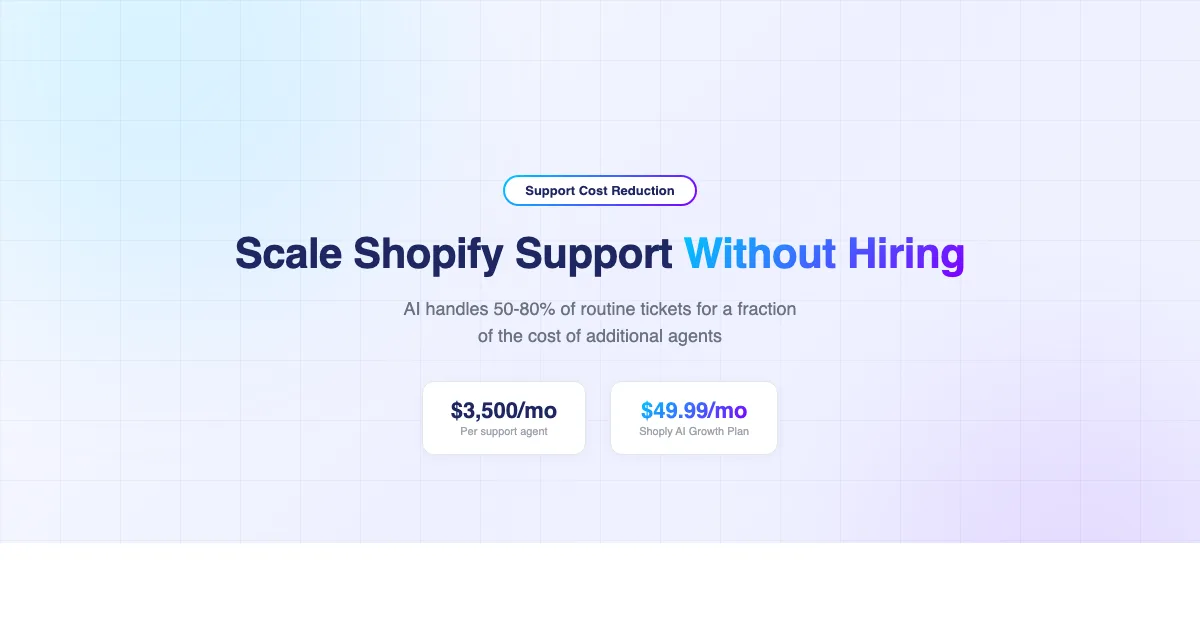
You can build scalable Shopify customer support without hiring a single new agent. The 50-80% of your tickets that are routine never needed a human in the first place, and that is exactly what AI takes off the queue. The math is straightforward: a full-time support agent costs $3,000 to $5,000 per month in salary and benefits. Shoply AI’s growth plan runs $49.99 per month and handles every product question, order status lookup, policy inquiry, and multilingual request your team would otherwise process manually. This article covers where that cost gap comes from, which ticket categories AI reliably automates, and how to structure your support operations around both.
For a broader look at ticket reduction methods, see How to Reduce Shopify Customer Support Tickets with AI: 5 Proven Methods.
The Growth Inflection Point Most Shopify Stores Hit
Support tickets do not scale with revenue. They scale with order volume, product variety, and the number of markets you serve. A store doing 100 orders per month might handle support comfortably with one person wearing multiple hats. At 500 orders per month, that same person is drowning. At 1,000 orders per month, you are either hiring or you are losing customers to slow response times.
The hiring instinct is understandable but expensive. AI chatbots now cost 95% less per conversation than live chat agents . A US-based customer support agent at $18-22 per hour, working 40 hours per week, costs roughly $3,200 to $3,800 per month before payroll taxes and benefits. You may also need coverage across multiple time zones, which compounds the cost. International stores often spend even more once you factor in the need for bilingual or multilingual staff.
The alternative is to automate the portion of your support volume that does not require human judgment. Most Shopify stores find that 50 to 80 percent of tickets fall into this category: questions with deterministic answers that your store already knows and just needs to communicate quickly. The bulk of ticket volume at most stores comes from:
- Product availability
- Shipping estimates
- Return window details
- Sizing guidance
- Order tracking
- Policy clarifications
These are not complex issues. They are high-frequency issues that eat agent time because they arrive by the thousands.
Shoply AI installs with zero-setup learning. It reads your product catalog, store pages, and policy documents automatically and begins answering questions from those sources on day one. There is no training period, no decision tree to build, and no FAQ entries to write by hand. The system handles over 1 million products with the same accuracy whether your catalog has 50 items or 500,000.
What AI Can and Cannot Handle
Understanding the boundary between automatable and human-required tickets is critical before you restructure your support operations. It determines how much volume you can realistically shift and how you should route the remainder.
AI handles pre-purchase product questions consistently and accurately. “Do you carry this boot in a wide width?” “What is the weight limit on this hiking pack?” “Is this compatible with my existing bindings?” These are questions with answers in your product data. Shoply AI’s combined search and chatbot interface processes them in natural language, so a customer can type a full sentence and get a specific answer, not a list of keyword-matched results to sift through. For the full breakdown of how reducing support tickets through better product search works in practice, see our dedicated guide.
Order status inquiries, the single most common ticket type at most stores, are fully automatable. Customers want to know where their package is, when it will arrive, and whether their return has been processed. Shoply AI integrates with Shopify’s order data and responds with current, accurate information.
This also covers a related category: out-of-stock inquiries. Rather than generating a support ticket or losing the customer entirely, Shoply AI’s back-in-stock notification feature lets customers subscribe to restock alerts for specific products and variants directly through the chatbot. When the item is available, they are notified automatically, and no agent touches the interaction at all.
Policy questions follow the same pattern. Return windows, shipping methods, international delivery, gift wrapping, and custom orders with standard workflows all have known answers that the chatbot retrieves from your store’s current policy pages. Unlike a static FAQ page, the chatbot reads your live content, so a policy change you make today is reflected in customer responses tomorrow.
What AI should not handle:
- Payment disputes
- Damage claims
- Situations requiring goodwill exceptions to policy
- Custom order negotiations where the outcome depends on human discretion
These require judgment, not information retrieval. A well-configured support operation routes these cases to agents directly, using the time savings from automated interactions to give agents more capacity per case on the complex ones.
The Compound Time Savings
Each automated support interaction saves roughly 5 to 10 minutes of agent time. That estimate accounts for reading the ticket, looking up the relevant information, writing a response, and closing the thread. Simple questions take 3 to 4 minutes. Questions requiring a product lookup or policy check take closer to 8 to 10 minutes.
At 200 automated interactions per week, that is 1,000 to 2,000 minutes of agent time recovered. That is 17 to 33 hours per week, a significant portion of a full-time employee’s capacity, at zero additional labor cost. At 500 automated interactions per week, the math starts to describe a full headcount reduction.
The multilingual dimension adds another layer to this calculation. Shoply AI supports 23 languages with automatic detection based on browser settings and customer preferences. A store selling to customers in Germany, France, Italy, and the Netherlands does not need separate support staff for each market. The chatbot responds in the customer’s language, generated from your English-language store content.
Hiring bilingual support agents for multiple European markets can cost $5,000 to $10,000 per month for even a small dedicated team. Multilingual AI coverage is included in the same $49.99 to $149.99 monthly plan.
For a detailed breakdown of how automated order tracking and returns handling work in practice, see Shopify AI chatbot for order status, tracking, and returns.
How to Scale Support Without Hiring More Agents
The goal is not to eliminate your support team. It is to eliminate the repetitive work so your team handles only the cases that benefit from human attention. This requires a deliberate routing structure.
Start by auditing your last 30 days of tickets by category. Sort them into automatable and human-required:
- Automatable: product questions, order status, policy, availability, multilingual
- Human-required: disputes, custom requests, damage claims, escalations
Most stores find that automatable tickets represent 60 to 75 percent of total volume. That percentage defines your potential reduction.
Shoply AI captures the automatable categories by default after installation. It answers product questions through natural language search and chat, handles order status through Shopify integration, and covers policies through store page ingestion. You do not need to identify specific questions to train it on. The system reads your store and generates answers autonomously.
The human-required cases continue through your normal ticketing workflow, whether that is email, a helpdesk like Gorgias, or Shopify’s built-in inbox. The practical difference is that your agents receive a much smaller queue of tickets, and those tickets are concentrated in the higher-complexity categories where their time adds real value.
One practical step: use Shoply AI’s smart FAQ link feature to preemptively answer high-frequency questions before customers open tickets. Adding ?shoply_question=What is your return policy? to links in your order confirmation emails, post-purchase pages, and site footer gives customers instant answers at the moments they are most likely to ask. Fewer pre-ticket questions means fewer tickets, full stop.
This same principle works for pre-purchase support. Embedding the chatbot on product pages so that “What size should I order?” and “Is this waterproof?” get answered in the browsing flow converts potential support tickets into buying decisions instead. How to Replace Your FAQ Page with a Smart AI Chatbot covers the implementation details for this approach.
Sports Basement demonstrates this model at scale across a large sporting goods catalog and multi-location retail operation; their full story is in How Sports Basement is Revolutionizing Omnichannel Sales with Shoply AI .
What does scalable Shopify support cost without hiring more agents?
The case for AI-first support operations becomes stronger as your store grows, not weaker. At 100 orders per month, the cost savings are modest. At 1,000 orders per month, automating 60 percent of support volume with a $149.99 per month plan instead of hiring a second agent at $3,500 per month represents $40,000+ in annual savings. At 5,000 orders per month, the comparison is between one AI plan and a dedicated support team of three or four people.
Shoply AI’s pricing structure reflects this scaling logic:
- The free plan handles 50 chats per month, suitable for stores testing the integration
- The $49.99 per month plan is appropriate for stores processing 200 to 500 orders monthly
- The $149.99 per month plan fits mid-size stores with higher ticket volume
- Enterprise-level coverage starts at $449.99 per month
All paid plans include a 14-day free trial.
The Built for Shopify badge on Shoply AI indicates it meets Shopify’s technical quality standards, which matters for stability, data handling, and the Shopify admin integration that makes order data available to the chatbot in real time.
For the complete picture of AI-driven support cost reduction across multiple methods, the parent guide is here: How to Reduce Shopify Customer Support Tickets with AI: 5 Proven Methods.
Frequently Asked Questions
Can AI really replace a support agent for Shopify?
AI handles 50-80% of routine ticket categories reliably: product questions, order status, policy inquiries, and multilingual requests. Complex cases like payment disputes and damage claims still need human review. The practical model is AI for volume, humans for judgment.
How does Shoply AI handle multilingual support without manual translation?
Shoply AI detects the customer’s language automatically from browser settings and URL language codes, then generates responses in that language from your English-language store content. 23 languages are supported with no additional configuration or language-specific setup required.
What does it cost to scale Shopify support with AI instead of hiring?
Shoply AI plans run $49.99 to $449.99 per month depending on usage volume. A full-time support agent in the US costs $3,000 to $5,000 per month. Stores automating 60% or more of ticket volume typically see a net savings of $2,500 to $4,500 per month per agent position they avoid filling.
How long does it take Shoply AI to start answering questions accurately?
Setup is same-day. Shoply AI reads your product catalog, store pages, and policies automatically after installation with no manual training. Most stores see immediate ticket deflection on product questions and policy inquiries from day one.
Get Started
Try Shoply AI free on the Shopify App Store or explore a live store integration at demo.shoplyai.ai . Paid plans include a 14-day free trial with no manual setup required. For the full breakdown of AI-based support reduction methods, see How to Reduce Shopify Customer Support Tickets with AI: 5 Proven Methods.