
Answer-First Content for Shopify Chatbots: 2026 Playbook
 Frederick Casey Housand - Apr 17, 2026
Answer-first content for Shopify chatbots means leading every product description, FAQ entry, and blog post with a direct 40-60 word answer before any setup, framing, or marketing copy. Your Shopify chatbot reads that content the same way a search engine does. Front-loaded answers get quoted cleanly in shopper replies. Buried answers get paraphrased, garbled, or missed entirely, which shows up on your storefront as vague chatbot responses and support tickets you did not need to field.
This post is a short playbook for merchants on how to write product descriptions, collection pages, FAQ content, and blog posts so the chatbot on your store actually quotes what you meant. If you are working through a full support-ticket-reduction plan, answer-first content is the writing precondition underneath our pillar guide on how to reduce Shopify support tickets with AI.
What answer-first content actually means, and why Shopify chatbots read it differently
Answer-first content leads with a direct, 40-60 word answer to the user’s likely question, followed by the supporting detail. The first sentence of every page, section, or FAQ entry should stand alone as a complete reply to the query a shopper typed in.
Before rewriting a page, check which store content Shoply reads so the answer is available to the assistant.
Here is a standard Shopify product description compared against an answer-first rewrite.
Before. “Welcome to our premium outdoor footwear line. Our boots are built for adventure and designed for those who demand quality and performance in every step of their journey. Crafted with care, each pair represents years of experience in outdoor gear…”
After. “Waterproof hiking boot, men’s sizes 8-14, 3mm Vibram sole, 2.1 lb per pair, rated to 30,000 feet of trail use. Runs true to size; order a half size up if you wear thick socks. Replaces our 2025 Model X with a lighter shank and improved ankle support.”
The difference matters because your chatbot reads the same content a search engine does. Shoply AI Chatbot uses zero-setup autonomous learning to ingest your product catalog, collection pages, policies, and blog posts directly. When the answer is buried, the chatbot extracts weak context and produces vague replies. When the answer is the first line, the chatbot cites it verbatim.
Four content surfaces are in scope:
- Product descriptions
- Collection page copy
- FAQ and policy pages
- Blog posts
Wiring those sources into the chatbot is a separate step covered in how to train Shoply AI Chatbot with your store knowledge. This post is about how to write them once they are wired.
What buried answers cost your store
Your chatbot runs on an extraction heuristic, not a reading comprehension test. It scans the top of a page, grabs what looks like the answer, and serves that to the shopper. If the top of the page is brand story, the chatbot either paraphrases that story (unhelpful) or guesses from context (risky). Either way the shopper ends up with a reply that does not actually answer the question they asked, and the next click is either abandonment or a support ticket.
The costs stack quickly across a catalog:
- Weaker extraction on high-intent product pages, which means more “not sure, please check the product page” replies and more drop-offs
- Higher ticket volume on sizing, fit, waterproofing, shipping, and returns because shoppers ask the chatbot, get a vague answer, and fall back to email
- Lost citations in Google AI Overviews and ChatGPT product answers, because those engines use the same extraction pattern your on-site chatbot does
Answer-first content is the fix for all three at once. It is a writing habit, not a technology change, which is why the pillar post on reducing Shopify support tickets with AI treats it as a precondition rather than a feature upgrade.
The four-rule answer-first playbook for Shopify content
Apply these four rules to every product description, FAQ entry, collection page, and blog post on your Shopify store. Four rules, not ten. If the top SERP results teach you a ten-step framework, you will read it once and not apply it. These are boring enough that you can apply them in an afternoon.
Rule 1. Lead with a 40-60 word answer
Write the answer to the most likely question first, in one or two short sentences. Save the brand story for later in the page. A shopper looking for waterproof hiking boots wants to know the waterproof rating, the weight, and the size range before they read about your founder’s trail epiphany.
Before. “Our boots celebrate the spirit of adventure…” After. “Waterproof hiking boot, 3mm Vibram sole, 2.1 lb per pair, men’s sizes 8-14. Runs true to size.”
Rule 2. Match the page title to the question a shopper would ask
Write product titles so the first few words are the defining spec, not a marketing label. Shopper search habits, search engines, and your chatbot all weight the start of the title heavily. A generic “Premium Performance Footwear” reads as filler to every one of them; a specific “Waterproof Hiking Boots, Men’s Size 11” reads as the answer.
Before. “Trailblazer Elite Boot - Premium Performance Footwear” After. “Waterproof Hiking Boots, Men’s Size 11, Vibram Sole”
Rule 3. Put the most common FAQ answer in the first paragraph, not in a dropdown
Accordion-style FAQ components hide the answer from both the chatbot and the AI engine. Your chatbot may or may not parse the dropdown content depending on how the theme renders it. The AI engine often does not. Put the top three answers in plain paragraphs at the top of the page and use the dropdown only for secondary questions. For the product angle on this, see how to replace your FAQ page with a smart AI chatbot.
Rule 4. Use declarative H2 headings that restate the question as a statement
Section headings that paraphrase the shopper’s question work much better for extraction than vague category labels. Shoply Site Chat and the Shopify chatbot both weigh H2 headings heavily when deciding what a section is about.
Before. “Sizing” After. “Do these boots fit true to size? Yes, with one exception.”
Each rule is cheap to apply per page. The cumulative effect shows up in chatbot quality within a week and in organic and AI-referred traffic within a month.
Before and after: an answer-first rewrite on a real Shopify product description
Here is a standard Shopify product description rewritten answer-first, with the chatbot output for each version. Same product. Same chatbot. Different writing.
Before (content on the page).
Welcome to the pinnacle of outdoor footwear. Our Trailblazer Elite Boot is the culmination of years of craftsmanship and a deep respect for the mountains. Designed for those who refuse to compromise, this boot delivers on every trail, every summit, every journey. Built with a rugged construction that honors the tradition of handcrafted gear, this is footwear engineered for adventure.
Chatbot output when a customer asks “are these waterproof and what sizes come in?”
The Trailblazer Elite Boot is designed for outdoor adventures with a rugged construction. For specific waterproof ratings and available sizes, I recommend checking the product page for complete details.
After (same product page, answer-first rewrite).
Waterproof hiking boot, men’s sizes 8-14 (half sizes from 8.5 to 12.5), 3mm Vibram Megagrip outsole, 2.1 lb per pair. Rated to 30,000 feet of trail use. Runs true to size; order a half size up if you wear thick socks. Ankle support is a full-height shank; lighter than our 2025 Model X by 0.3 lb.
Chatbot output after the rewrite.
Yes, they are waterproof and come in men’s sizes 8 through 14, including half sizes from 8.5 to 12.5. They run true to size; size up a half if you wear thick socks.
The screenshot below is our public demo chatbot, running on the Sports Basement catalog we use for public testing. You can test any prompt yourself and see how the chatbot sources answers from the storefront content.
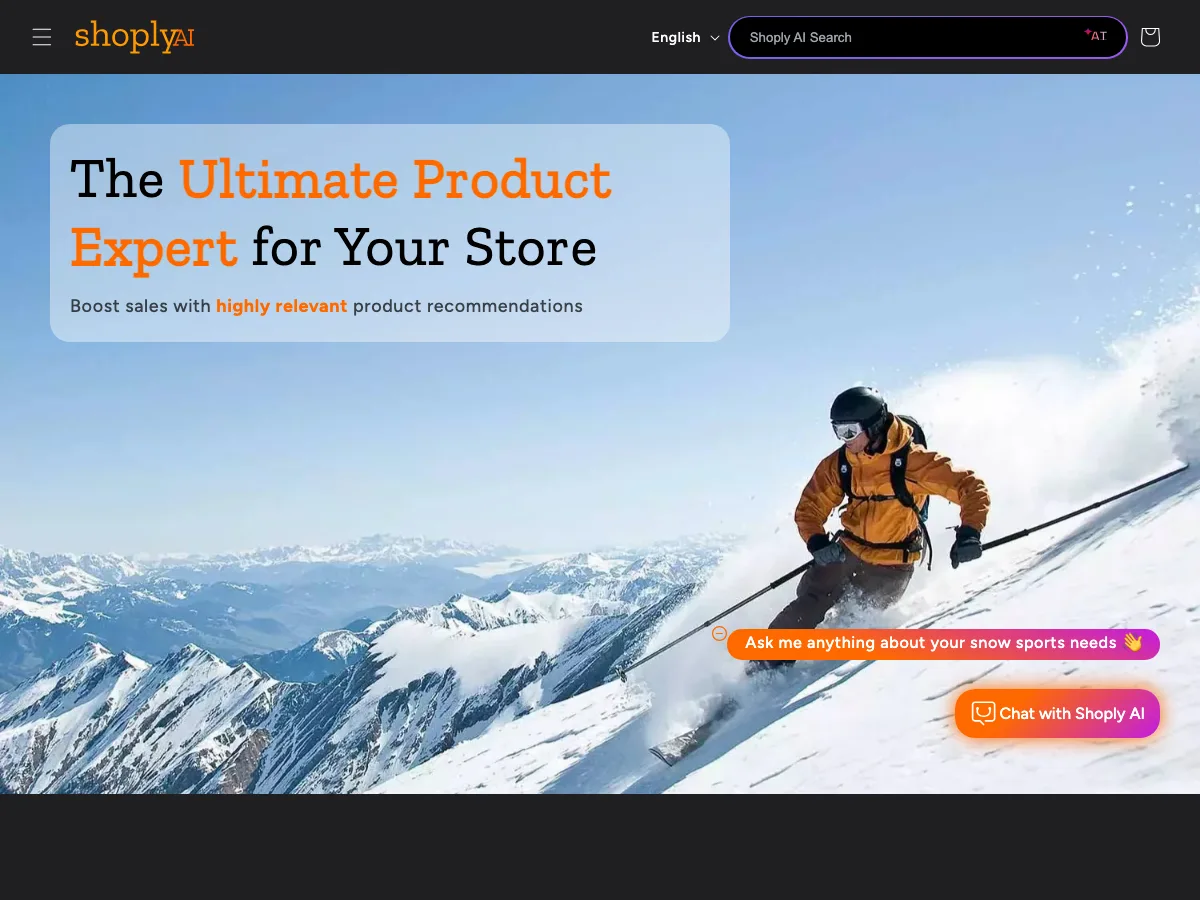
The shift is small on the page and large in the output. One paragraph of specifics replaces three paragraphs of throat-clearing. The chatbot quotes the spec line directly instead of punting the customer back to the product page. The same content change helps your Google AI Overview and ChatGPT citations for order-status and return-policy queries, which is the pattern our post on AI chatbot order tracking and returns for Shopify walks through in more depth. Clean quoting is a conversion lever too, not only a deflection one; five ways a Shopify chatbot increases conversion covers the revenue side.
Frequently asked questions
What is answer-first content for a Shopify chatbot?
Answer-first content leads every page, product description, or blog post with a direct 40-60 word answer to the likely shopper question before any setup or marketing framing. Shopify chatbots that read your storefront content, including Shoply AI Chatbot, extract these leading answers and use them as replies.
How do growing Shopify stores handle returns without hiring more staff?
Route return questions through a chatbot trained on answer-first return-policy content. Shoply AI Chatbot extracts directly from your policy pages when the answer is in the first paragraph, which deflects common return questions without a human agent needing to touch the ticket.
Does answer-first content hurt SEO for longer-form blog posts?
No. Answer-first content improves both AI engine citations and traditional SEO snippet extraction. The same paragraph structure that an AI engine quotes is what Google uses for featured snippets. Rewriting for answer-first almost always lifts both at the same time.
Can AI chatbots pull real-time order status from Shopify?
Yes. Shoply AI Chatbot integrates with Shopify Admin for live order status, returns, and cancellations, and answer-first order-policy content improves how the chatbot frames follow-ups when shoppers ask about shipping, refunds, or subscription changes.
Get started
Install Shoply AI from the Shopify App Store or test the chatbot on our live demo store . Setup is zero-touch; the chatbot reads your catalog, pages, and blogs as soon as it is installed. For the full playbook on how answer-first writing fits into a support-ticket-reduction plan, start with the pillar guide on reducing Shopify support tickets with AI.