
Is English Enough for Your Shopify Store? 7 Leaks (2026)
 Frederick Casey Housand - Jun 22, 2026
Is English enough for your Shopify store? For most stores the honest answer is no, and the cost shows up as international shoppers who leave without a trace. About 35% of a typical store’s traffic comes from abroad, yet the visitors who hit a language or currency wall rarely complain. They just leave, and your own analytics logs every silent exit. (Updated: June 2026.)
So what are you losing to an English-only storefront? Seven specific leaks, every one already named in data you own. I would rather you spend an afternoon finding which leak is costing you than a month installing a translation app for a problem you never measured. Each leak below points to the exact spot in Google Search Console and Shopify analytics to confirm it, then fix it. A self-audit, not another translate-your-store pitch.
The leak-audit map: where each one hides in your own reports
Every leak lives in a report you already own. Native fixes close five; two (Leak 2 and Leak 5) hit a ceiling page translation cannot cross.
1. Is your store silently sending every international visitor the English storefront?
The most common leak is locale auto-detection that never fires. A shopper in Germany lands on your USD, English storefront, sees prices that are not theirs, and leaves in seconds. To you it looks fine; to them it is the wrong store.
Audit: in Google Search Console add the Country dimension, then compare Shopify Analytics > Sessions by location against Conversion by location. The tell: a country sending real session volume at a conversion rate near zero.
Fix: turn on the Shopify Markets language and currency selector and verify the auto-redirect fires for a non-home IP. 33% of shoppers abandon when priced only in a foreign currency, per Shopify’s cross-border guide , so currency matters as much as language. Chatbot handling differs by vendor: multilingual AI chatbot for Shopify .
2. When a non-English shopper searches your store, does anything come back?
When a German shopper types “wasserdichte jacke” into a store indexed in English, the search returns nothing and they leave. This is the leak translation apps cannot fix: translating your theme does not translate catalog retrieval. The chrome is German, the index is still English tokens, and the highest-intent action returns a blank page.
Audit: open Shopify Search & Discovery > top searches with no results and scan the tail for non-English terms, then cross-reference them in your GSC query report. Searches in their language hitting zero results is the leak that costs you ready-to-buy visitors.
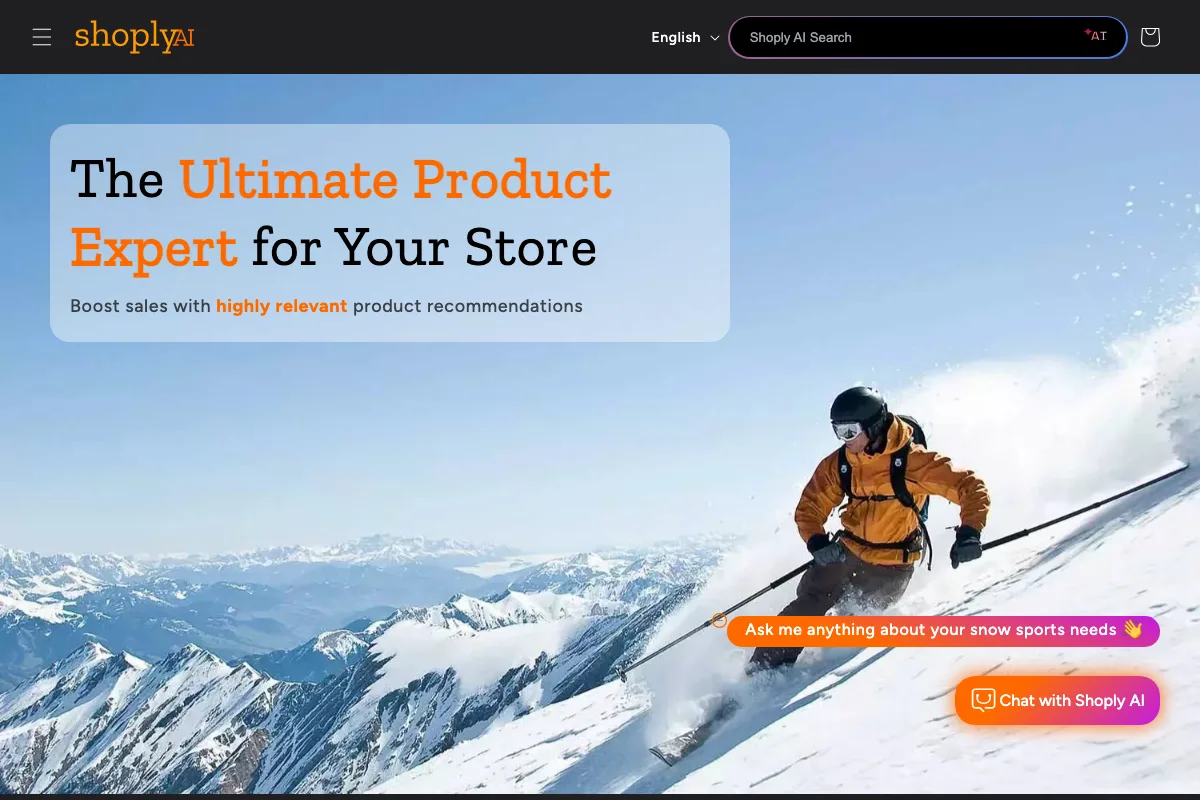
Fix: per-language synonym lists do not scale past the first language boundary. Shoply AI Search does semantic, language-agnostic retrieval across 23+ languages, so “wasserdichte jacke” resolves to your waterproof jackets without a synonym table. Deeper: Shopify site search log audit and the Shopify search synonyms trap .
3. Are your variant attributes still in English under a translated theme?
A translated theme can still ship English product truth. Headings and buttons are localized, but the size chart, material, fit, and care fields under each variant stay English, so a French shopper cannot tell which option is theirs and abandons. The storefront looks localized; the catalog is not.
Audit: spot-check three translated product pages for English variant labels, and check how much of product.options your Shopify Translate & Adapt coverage reaches.
Fix: translate variant metafields and option values, not just theme strings. Where coverage is incomplete, zero-setup catalog learning reads your catalog as it stands: training AI on your Shopify catalog .
4. Do shoppers hit a currency, duty, or shipping surprise at the worst moment?
The price looked right until checkout reset it to USD, or a duty estimate appeared for the first time on the final screen. IPcam-shop in the Netherlands and Puffo Sport in Italy both sell to shoppers who expect the cart total to hold from product page to payment; when it does not, they leave. Cross-border duty is the surprise home-market testing never catches.
Audit: in Shopify checkout analytics, compare checkout-initiated against checkout-completed by country. The country that starts and does not finish is eating a price surprise.
Fix: enable Shopify Payments multi-currency (mind the Advanced and Plus charge-versus-display limits) and surface duty estimates early. These also drive “where is my duty charge” tickets: reducing support tickets with AI .
5. Does your chatbot quietly fall back to English the moment the question gets specific?
Most “multilingual” chatbots wrap an English model in a translate API. That holds for FAQ templates and breaks the moment a non-English shopper asks something catalog-specific: the product name back-translates into something wrong, or the bot reverts to English. Invisible to you, obvious to them.
Audit: open your own bot, switch to a customer language, and ask a catalog-specific question, not a generic one. Watch for the moment it flips to English or invents a product name.
Fix: a combined AI Search + Chatbot reads the catalog directly with live-state reads and detects the shopper’s language instead of translating around it. At Puffo Sport, customers routinely mistake the bot for a human. Field notes: running 23 languages in production and the anatomy of a Shopify chatbot conversation .
6. Is Google even indexing your localized storefronts?
International shoppers cannot bounce from a page they never reach. Missing hreflang tags and absent locale sitemaps mean Google serves your English page into every market, or serves nothing, so your localized URLs never enter the results foreign visitors search. This leak sits upstream of the store.
Audit: open the GSC Pages report, filter by locale path (/de/, /fr/, /nl/), and check the Coverage state per locale. Our own indexing work confirmed localized routes index only once the hreflang and sitemap wiring is correct, so verify rather than assume.
Fix: configure hreflang through Shopify Markets, submit a sitemap per locale, and confirm each URL in GSC URL Inspection. An unindexed storefront is a leak no on-page translation can close.
7. Does the checkout language reset and break trust at the final step?
Shopify ships 33 pre-translated checkout languages, but third-party checkout apps and UI extensions frequently do not localize, so a storefront browsed in French can flip to English at payment. Trust collapses at the highest-intent moment.
Audit: run a full test purchase in a non-default language and watch the checkout UI extensions and post-purchase pages, not just the storefront. The reset usually hides in an app you forget is in the checkout path.
Fix: verify each checkout app’s localization against the Shopify markets documentation and replace the ones that do not localize. Over 50% of shoppers will not buy in a language that is not theirs, per Shopify’s localization guidance . More on one combined surface: AI shopping assistant versus chatbot .
Frequently asked questions
Is English enough for a Shopify store that sells internationally? Usually not. An English-only storefront loses international shoppers to seven specific leaks: undetected locale, in-language search returning nothing, English variant specs, checkout currency or duty surprises, a chatbot that falls back to English, unindexed localized URLs, and a checkout that resets language. Each is checkable in your own GSC and Shopify data.
How do I find which countries are bouncing in my own data? Add the Country dimension in Google Search Console, then compare Shopify Sessions by location against Conversion by location. A country with real session volume and near-zero conversion is a confirmed leak.
Does Shopify automatically translate my store for international customers? Partly. Shopify Markets and Translate & Adapt localize theme strings and ship 33 checkout languages, but variant attributes, specs, and many third-party checkout apps are frequently left in English. Page translation also does not translate catalog search retrieval.
Why does my Shopify search return nothing for non-English shoppers? Native Shopify search matches English tokens, so “wasserdichte jacke” against an English-indexed catalog returns zero results even when you stock the product. Semantic retrieval across 23+ languages resolves it without a synonym table.
Can a Shopify chatbot actually answer in 23+ languages, or does it fall back to English? Many bots wrap an English model in a translate API and revert to English on catalog-specific questions. Shoply AI detects the shopper’s language and reads the catalog across 23+ languages, which is why Puffo Sport customers mistake the bot for a human.
Does Shopify checkout support multiple languages and currencies? Yes: 33 pre-translated languages and multi-currency through Shopify Payments, with charge-versus-display limits on certain plans. The common failure is a third-party checkout app that resets the language to English at payment.
Run the audit, then decide where the manual fix runs out
Five of these seven leaks close with native Shopify tools and an afternoon. The two that do not, in-language search and a chatbot that reverts to English, are where translating the page stops being enough: retrieval and conversation are not page chrome.
If your audit lands on those two, Shoply AI Search and Chatbot reads your catalog directly across 23+ languages, on one combined surface no other Shopify app currently ships. See it on a real catalog at demo.shoplyai.ai or install Shoply AI . Happy auditing.