
How a Shopify AI Chatbot Conversation Works
 Frederick Casey Housand - May 21, 2026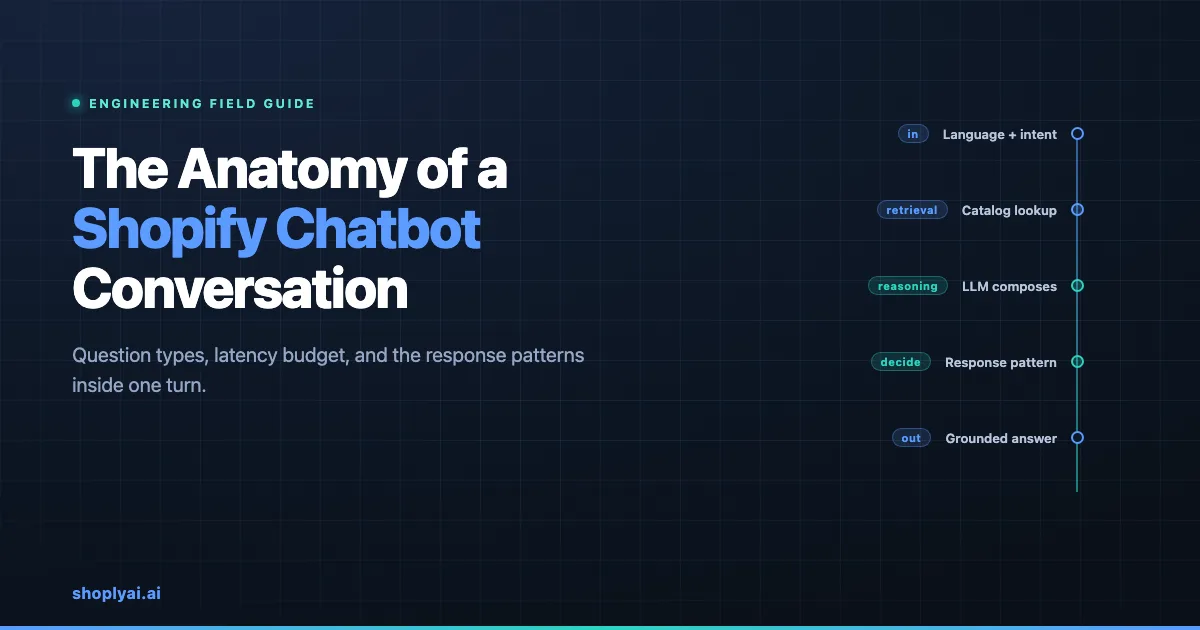
A Shopify AI chatbot conversation is a sequence of three to five turns. Each turn spends a measurable budget split between catalog retrieval and language reasoning. What matters is not whether a bot “uses AI” but how one turn divides that work, because the division decides whether the bot converts on the third question or stalls.
I would rather profile a conversation than describe a chatbot. A description hides the parts that decide the outcome: the question the shopper opened with, the time before any words appear, and the choice between answering, clarifying, and handing off. Most “how does a Shopify AI chatbot work” content stops at “it uses AI to answer questions” and never opens the box.
This post opens it. One conversation breaks into four systems you can see and reason about:
- A taxonomy of questions the shopper actually asks.
- A latency budget each turn spends.
- A split between retrieval and reasoning under every answer.
- The response patterns the bot picks between.
If you are still choosing a tool, the comparison pillar covers which vendor fits. For the demand side of the same data, see the companion analysis of 23,000 conversations .
I help build Shoply, an AI Search and Chatbot for Shopify, so I will be specific about where each part is a structural advantage rather than a setting you toggle. Two of the four are where the real moat sits: how the bot retrieves, and how it stays current with the catalog.
What kinds of questions do Shopify shoppers actually ask a chatbot?
A Shopify chatbot fields a small, repeating set of question types, and most are not the FAQ questions vendors design for. Each category is answered by a different subsystem, which is why a bot tuned for one type fails the others. The taxonomy below is the legend the rest of this post reuses.
Which type leads depends on the store:
- Apparel (23.3%), Home & Garden (19.1%), Beauty & Fitness (11%) make up more than half the customer base, and there the opening question is almost always availability, not features.
- At Sports Basement, a Bay Area omnichannel retailer, turn one is often a stock-and-location query reading live store state.
Feature and fit questions arrive on turn two or three. Most best-practice advice optimizes for FAQ-style policy questions, which are a turn-three event, not a turn-one event. The taxonomy inverts that priority: design for the availability open, then route the rest to the subsystems that answer them.
The category you open with also predicts the failure to watch for:
- Availability and order-status lean on retrieval and live state. They answer cleanly when the index is fresh and fail loudly when it is stale.
- Comparison and out-of-catalog lean on reasoning, where the risk is a confident answer with no fact under it.
The order-tracking and returns patterns cover the post-purchase branch, and replacing a static FAQ page covers the policy branch.
The taxonomy only works if the bot already knows the store before turn one. This is the first moat: Shoply learns the catalog, pages, and blogs on its own with zero setup, so it can answer an availability open without anyone scripting intents, and it relearns as the catalog changes instead of going stale between updates.
Where does a chatbot spend the time between question and answer?
A single chatbot turn is a sequence of timed stages, not one model call. The budget those stages spend is usually what a shopper feels as slow, not the model itself. Retrieval and generation dominate the budget; the small stages around them are cheap. The waterfall below shows the shares, not absolute milliseconds, because felt speed is a ratio between stages.
Two stages carry real weight on a Shopify store:
- Language detection is a genuine line item, not a rounding error. The bot supports 23+ languages with automatic detection and has to commit to one before it can retrieve or reason.
- Retrieval is the other pressure point. At catalog scale, on stores with 1M+ products, finding the one true fact is heavier than composing the sentence that reports it.
The waterfall below is a representative budget: a share of total turn time, not a measured figure from any one store. Real numbers vary by catalog size, model, and network. Independent benchmarks of retrieval-augmented generation latency show retrieval and generation as the two largest contributors to response time, which is the shape below.
Teams obsess over which model to run. Shoppers feel the budget. A fast small model with slow retrieval loses to a slower model with fast retrieval, because two of every three units of felt time live in the retrieval and generation bars. Language detection is where multilingual stores leak time, which is why running 23 languages in production and the multilingual chatbot architecture both treat detection as a first-class budget line.
This is where the second moat shows up. Shoply detects language automatically across 23+ languages and runs retrieval against catalogs of 1M+ products, so the two heaviest stages are the ones it is built to absorb rather than the ones that break first. At Puffo Sport in Italy, shoppers routinely mistake the bot for a human, and that illusion only survives when the whole budget stays inside the window a person would tolerate.
Retrieval vs reasoning: which part of the bot is actually answering?
The word “AI” hides two separate jobs in a chatbot, and most failures belong to the quieter one. They are different machines with different failure modes, and the split maps directly onto a combined AI Search and Chatbot, where retrieval is the AI Search layer feeding the chatbot.
- Retrieval finds the true fact: semantic search over the catalog, an embedding or vector lookup, a live read of order and inventory state.
- Reasoning decides what to say: the language model composing a grounded answer in the store’s voice.
When a bot “hallucinates” a return window or invents a stock status, that is almost never the model being creative. It is the retrieval layer handing the model nothing to ground on, so the model fills the gap. This is where RAG actually lives, the architecture the most technical competitor page in the results names once and never decomposes. The index is populated by zero-setup autonomous learning from catalogs, pages, and blogs, so the quality of the answer is set before the model is ever asked.
Matching quality at the retrieval layer is measurable, not vibes. In our own AI-query fingerprinting, pages whose titles matched a query exactly drew a 52% click-through rate; one-word-off mismatches drew 0%. The same mechanic governs a conversation: exact retrieval grounds a converting answer, approximate retrieval grounds a confident wrong one. The two-lane diagram below routes a single taxonomy question through both jobs.
The practical consequence: fix retrieval before you tune prompts. Search and chat are the same retrieval problem viewed from two angles, and a bot that shares one index across both stays consistent. Populating that index is its own discipline, covered in training the chatbot on your store knowledge , and auditing what it returns is the site-search log audit , which treats the search log as retrieval ground truth.
This is Shoply’s core bet, and the moat that is hardest to copy: the AI Search engine and the chatbot are one system. The bot reasons over the exact index shoppers search, so a product the search bar can find is a product the chatbot can ground on. Most tools bolt a chat layer onto a separate search index, which is why turn three so often reaches for context the search side never saw. Combining the two is an architecture decision made on day one, not a feature added later.
The response patterns a chatbot chooses between on every turn
After retrieval and reasoning, a Shopify chatbot picks one of a small set of response patterns, and the choice, not the wording, is what converts or stalls. Each is gated by confidence, and the decision tree below tags each leaf with the question types it serves:
- Direct answer when the fact is retrieved and confidence is high.
- Clarify when the question is ambiguous.
- Recommend when several grounded options fit.
- Take action when the turn reads or writes live state, like an order lookup or cancellation.
- Refuse and hand off when the answer falls outside the catalog.
The under-built pattern is graceful refusal. A bot that confidently guesses costs more trust than one that says “let me get a person on this,” and that matters most at the third-turn objection. An answer-first response structure makes the direct-answer leaf land cleanly; the action leaf is where order tracking, cancellation, and returns happen. The recommend leaf is where an assistant and a chatbot differ: an assistant recommends proactively, a chatbot waits to be asked, the distinction worth understanding before you buy . Tuned well, refusal and handoff are what reduce support tickets , because they route the hard cases to people instead of burying them in a wrong-confident answer.
The take-action leaf is where the live-state moat pays off. Shoply reads order and inventory state through the Shopify Admin and Checkout integrations, so an order-status or stock answer reflects the store at the moment of the question rather than a cached snapshot. A pattern is only as honest as the data under it, and reading live state is what keeps the action leaf from confidently quoting yesterday.
How the four parts compose into one converting conversation
A real Shopify conversation is these four systems firing in sequence, three to five times. The taxonomy sets the question type, the latency budget paces the turn, the retrieval and reasoning split grounds the answer, and the response pattern decides the move. The turn most bots are not designed for is the third and it is also the one most likely to convert, because by then the shopper has confirmed the product exists and is testing whether it fits. The annotated table below walks one apparel conversation across three turns.
The shape holds across stores and languages. At IPcam-shop in the Netherlands, the same arc plays out across a mid-session language switch, where the language-detection budget reappears on every turn. The third turn survives on Shoply because its AI Search and chatbot are one system: retrieval keeps the answer grounded as the question narrows, reasoning keeps it in the store’s voice, and zero-setup learning means the index already saw the product the shopper is now narrowing toward. The four moats are not four features. They are one architecture doing four jobs.

Conversion is not a switch you flip. It is the fifth thing that happens when the first four are fast and grounded, the through-line of how a chatbot increases conversion . For the engineering history, how we built a smarter chatbot tells the build story, and the comparison pillar maps how different tools handle each of these four parts.
Frequently asked questions
How does a Shopify AI chatbot work?
A Shopify AI chatbot answers each shopper question in a short sequence of timed stages: it detects language and intent, retrieves the relevant catalog or order fact, reasons over that fact with a language model, and chooses a response pattern. A typical conversation runs three to five turns, and most of the work in any turn is retrieval and generation rather than the small stages around them.
What is the response time of a Shopify AI chatbot?
The felt response time of a Shopify AI chatbot is the sum of its per-turn latency budget, dominated by retrieval and generation rather than by any single setting. Treat it proportionally: roughly two of every three units of turn time live in the retrieval and reasoning stages, so a fast model with slow catalog retrieval still feels slow. Absolute milliseconds vary by catalog size, model, and network.
What types of questions can a Shopify chatbot handle?
A Shopify chatbot handles six recurring question types: availability and stock, fit and specification, post-purchase and order status, policy and returns, comparison and recommendation, and out-of-catalog requests that need a handoff. Each is answered by a different subsystem, with availability and order-status questions leaning on retrieval and live state, and comparison questions leaning on reasoning.
Can a Shopify AI chatbot pull real-time order status?
Yes. Order-status questions are a retrieval-plus-action pattern: the bot reads live store state through the Shopify Admin and Checkout integrations rather than a cached snapshot, then reports the current status. This is the same machinery that powers order tracking, cancellation, and returns , and it is why the answer reflects the order as it stands at the moment of the question.
What is the difference between retrieval and reasoning in a chatbot?
Retrieval finds the true fact in the catalog, knowledge base, or live store state. Reasoning decides what to say and composes it in the store’s voice. The distinction matters because most wrong answers are retrieval failures dressed as reasoning failures: the model grounded faithfully on a fact that was approximate or stale, so fixing the index usually beats tuning the prompt.
See a turn handled live
The anatomy above is what we design against: short turns, grounded retrieval, and a response pattern chosen on confidence rather than guessed. To watch one turn handled end to end, the live demo is open, and the app installs from the Shopify App Store with a combined AI Search and Chatbot on one index. To compare how different tools handle the four parts, the best AI chatbots for Shopify in 2026 guide is the companion read.