
Updated
5 AI Tools That Actually Upgrade Your Shopify Store in 2026
 Frederick Casey Housand - Jul 6, 2026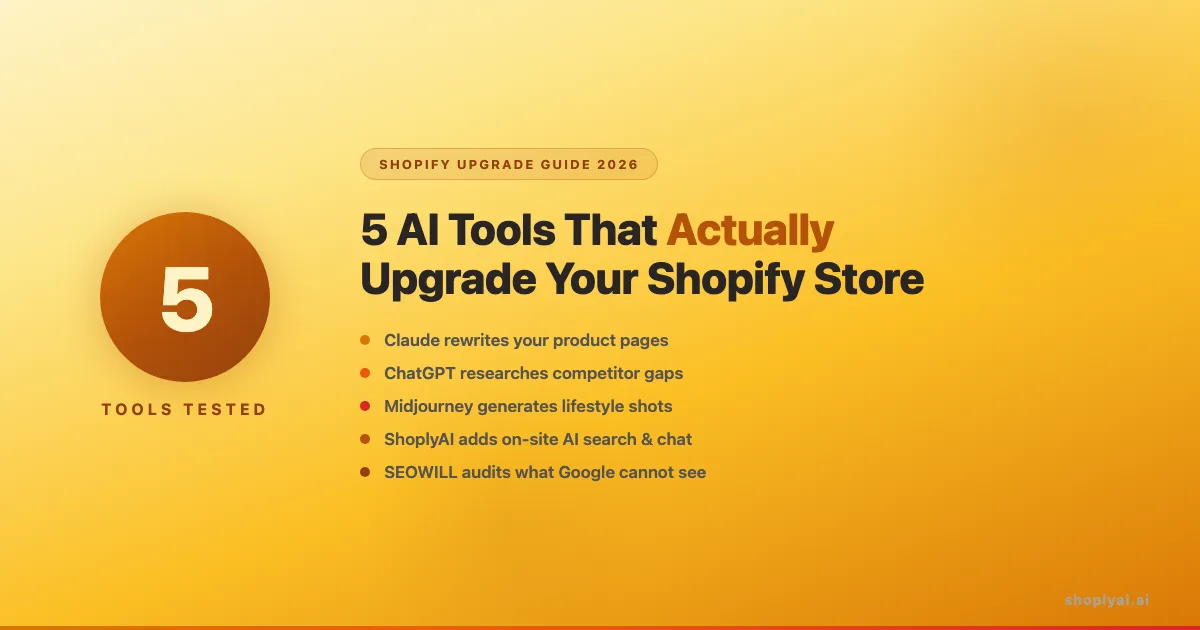
Most “AI tools for Shopify” roundups read like App Store directories. Tax calculators. Shipping dashboards. Bookkeeping software. The tools that change your store are the ones your customers feel: product pages that answer questions before shoppers ask, on-site AI that knows which variant is in stock right now, images that make a $40 product look real.
I tested five AI tools against one real Shopify store. 200 SKUs. Thin product descriptions. No on-site AI. A help center last updated in 2024. One afternoon. Each tool got one job. Here is what worked.
Can Claude actually write product descriptions that sell?
The practical guide explains how to use Claude for Shopify store work, including prompts and its limits.
Yes, if you give it the right inputs. Claude does not read your live Shopify catalog, but give it three things, competitor product pages, real customer reviews, and a short brand voice doc, and it writes descriptions that are better than what most stores publish.
The prompt: “You are writing product descriptions for a Shopify store. Here are three competitor product pages and three verbatim customer reviews. Lead with what customers actually say, use their phrasing, and close with the one detail competitors leave out.” The output led with “the fabric held up after six washes, which is more than I can say for the Zara version” instead of the generic “premium quality cotton blend” the original page used.
Claude’s Projects feature, upload your catalog CSV once, generate descriptions in batch, turned a 30-SKU afternoon into 20 minutes. The catch: it wrote a description for a color variant discontinued last month. Every batch needs a human pass to verify stock and pricing. For stores with frequent catalog churn, pair Claude with a tool like ShoplyAI that reads live inventory. Read best AI automation tools for Shopify in 2026 for the back-office side of the stack.
ChatGPT’s live search finds competitor weaknesses Claude misses
Claude writes better. ChatGPT with web search researches better. Feed it a competitor’s URL and ask, “What are customers complaining about in App Store reviews and on Reddit?” It names the exact pain points.
For our test store, a boutique apparel brand, ChatGPT found three recurring complaints from a competitor’s reviews: the chatbot could not check inventory, shipping estimates were wrong, and returns took three emails to resolve. Those became differentiation bullets on our product pages. The prompt that worked: “Identify the three most common complaints. For each, write one product-page bullet that positions our store as the alternative that solves it.”
The catch: web search pulls reviews from 2024 alongside 2026. Two complaints were from an old app version rebuilt last year. Verify every claim before you publish. For a deeper walkthrough, read how Shopify owners actually use ChatGPT. Stores with cart abandonment issues should also see how AI chatbots reduce Shopify cart abandonment.
Can Midjourney generate product images that look real?
Nearly. Midjourney v7 with image reference mode produces lifestyle shots hard to tell apart from photography. Feed it a clean product-on-white shot, describe the scene, iterate three times. The output looks like a studio shoot.
For our test store’s linen shirt, Midjourney produced a sunlit bedroom shot that was better than the flat-lay the store had used for months. For a ceramic mug, it placed the product on a desk beside a laptop, warm and contextual.
The catch: one image hallucinated a logo. The shirt in the generated image had a small embroidered emblem that does not exist on the real product. Another image changed the mug’s color from sage green to mint. For supplements or cosmetics, any regulated category, skip this tool entirely. For apparel and home goods with a human QC pass, it is a real upgrade for stores that cannot afford a photo studio.
Can on-site AI answer shopper questions on day zero?
This was the surprise of the sprint. Most Shopify AI tools demand setup: synonym lists, FAQ uploads, intent training flows. ShoplyAI skips all of it. Install from the Shopify App Store. It reads your catalog. It starts answering questions in about ten minutes.
The difference from a traditional chatbot: ShoplyAI reads the live catalog, not a static FAQ. When a variant sells out, the answer changes. When a new collection drops, it knows without a manual update. It handles 23+ languages and catalogs up to 1M+ products, same architecture at 50 SKUs or 50,000. For a step-by-step guide, read how to add AI search to a Shopify store.
The catch: Shopify-only. Multi-platform stores need a separate solution for non-Shopify channels. Stores with large international catalogs can read running 23 languages in production for the field report.
The tool that does the invisible work: technical SEO
SEOWILL audits what Google sees that you do not. Our test store had fourteen issues: six products with identical meta descriptions, three collection pages missing index tags, two oversized images, and three broken links from a 2024 catalog restructure.
The audit took fifteen minutes. Fixing took under an hour. SEOWILL finds the gaps. Claude writes the fixes. For duplicate meta descriptions, I fed SEOWILL’s report into Claude and asked for unique replacements, one workflow closed all six. For the broader AI-search landscape, read best AI search for Shopify in 2026. For the agentic commerce angle, see agentic AI for Shopify in 2026.
The one-afternoon upgrade stack: which tool does which job
| Your store’s weak spot | Start with this tool | Time | Cost/mo |
|---|---|---|---|
| Thin product pages | Claude | 30 min | Free to $20 |
| Competitors outranking you | ChatGPT (web search) | 20 min | Free to $20 |
| Flat-lay product photos | Midjourney | 20 min | $30 |
| Shoppers bounce instantly | ShoplyAI | 10 min | Free to $50 |
| Zero visibility into SEO gaps | SEOWILL | 15 min | $29 |
If your product pages are the weakest link: Claude, then ChatGPT, then SEOWILL. Rewrite the copy, research competitor positioning, audit the technical foundation. Add ShoplyAI last, product pages convert better when shoppers can ask questions about what they are reading.
If shoppers bounce without engaging: ShoplyAI first. A shopper who lands on a product page and leaves in eight seconds was asking a question the page did not answer. On-site AI that reads inventory catches those bounces before they happen.
If you are getting traffic but no conversions: the problem is usually trust. Claude descriptions that cite real customer reviews build more trust than generic copy. ChatGPT research that names competitor pain points gives shoppers a reason to stay. Midjourney images that show the product in context close the imagination gap. For stores where products are not showing up in search at all, read why Shopify products do not appear in AI search, it is usually a catalog indexing issue.
The full stack took under two hours. Total monthly cost: about $80, less than one hour of a contract copywriter’s time. Read best AI search for Shopify in 2026 for a detailed comparison of AI search tools.
Frequently Asked Questions
Do I need all five AI tools to upgrade my Shopify store?
No. Start with the tool that fixes your weakest spot. Thin product pages? Start with Claude. Shoppers bouncing? Start with ShoplyAI. The stack is modular, pick the tools that match your gaps and skip the rest.
Is Claude better than ChatGPT for Shopify store tasks?
They do different jobs. Claude is the stronger writer for long-form product descriptions, brand voice consistency, and multi-page strategy documents. ChatGPT with web search is the stronger researcher for real-time competitive intelligence. Use Claude for creation, ChatGPT for research.
Can ShoplyAI replace my existing chatbot like Tidio or Gorgias?
ShoplyAI is a combined AI Search plus Chatbot that reads your live product catalog instead of matching FAQ keywords. If your current chatbot needs manual synonym lists and FAQ training, ShoplyAI replaces that workflow. If you need a multi-channel helpdesk covering email, phone, and social, keep your helpdesk alongside it.
How much does it cost to upgrade a Shopify store with AI tools?
Claude and ChatGPT have free tiers enough for a single-store operator. Midjourney is $30/month, SEOWILL is $29/month. ShoplyAI has a free plan with paid tiers starting at $49.99/month. A Claude-plus-ShoplyAI minimum stack costs under $50/month. The full five-tool stack costs about $80/month.
Can AI-generated product images get my store banned?
Shopify permits AI-generated images. The risk is misrepresentation in regulated categories like supplements and cosmetics where product appearance is a compliance issue. For apparel and home goods with human QC, AI-generated lifestyle shots are a low-risk upgrade. Verify product details before publishing.
Will Google penalize AI-written product descriptions?
Google penalizes spammy auto-generated content, keyword-stuffed, low-effort, mass-produced pages. AI-assisted content that is specific, accurate, and human-reviewed falls within Google’s guidelines. The Claude descriptions in this test included real customer review quotes and specific product details.
Which AI tool should I install first if I only have 30 minutes?
ShoplyAI. It takes ten minutes to install and learn your catalog. The AI starts answering shopper questions immediately without configuration. If your store already has decent product descriptions and images, on-site AI is the highest-leverage upgrade in the stack.
Get Started
One afternoon and about $80/month gets you product pages that sell, images that look real, on-site AI that answers questions, and a technical foundation Google can read.
If your store is missing on-site AI, the thing that catches shoppers before they bounce, try ShoplyAI’s free plan on the Shopify App Store . It reads your catalog, learns autonomously, and starts answering questions in about ten minutes. No setup. No synonym lists. No manual training. Paid plans include a 14-day free trial.
See a live store integration at demo.shoplyai.ai .