
Agentic AI for Shopify: 7 Real Capabilities and 4 Bluffs in 2026
 Frederick Casey Housand - Jun 18, 2026
Agentic AI for Shopify means an assistant that reads your live store state and takes a bounded action on it, and most tools selling the word in 2026 do neither. I would rather an assistant answer three questions correctly from live data than narrate ten it guessed, because a guessed stock count costs you the sale and the trust. Here is the test we run, and the seven a real one passes.
The rebrand timing is no accident. Tidio, Chatty, and Alhena all renamed “chatbot” content “agentic” the same week we scraped them, and Shopify shipped its Universal Cart Protocol and Agentic Plan on top. Every vendor owns the label; almost none let you check it. What follows is the runtime view, what the assistant on your store does for a shopper. The automation-tools roundup is where you pick one once you know what is real.
What is the two-question test for agentic AI?
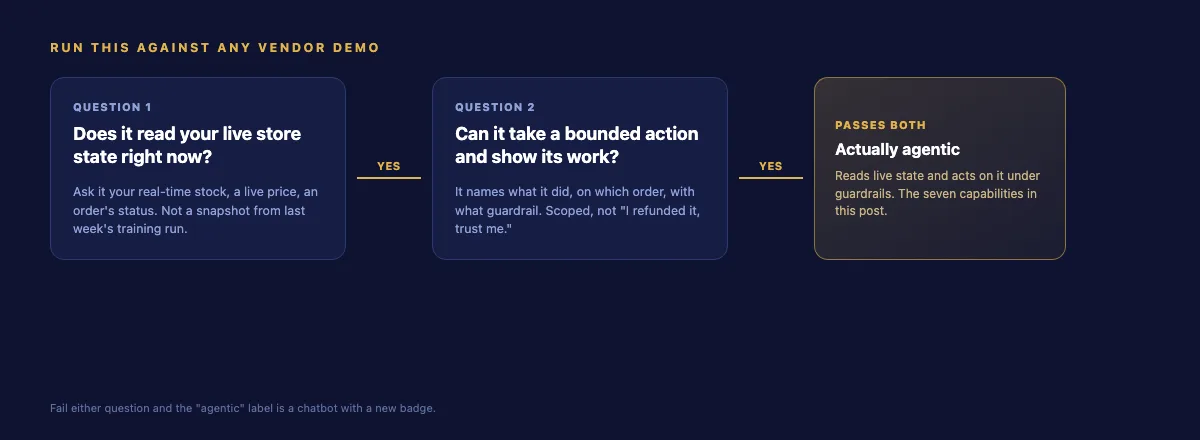
The two-question test is a falsifiable check you can run in one demo. Question 1: does it read your live store state right now? Ask your real-time stock or an order’s status, and watch whether it answers from live data or a week-old snapshot.
Question 2: can it take a bounded action and show its work? A real agent names what it did, on which order, under which guardrail. Fail both and it is a chatbot with a new badge.
Plot every claim on those two axes and the category sorts itself: the capabilities that read live state and act cluster in one corner, the relabelled bots in the opposite one.
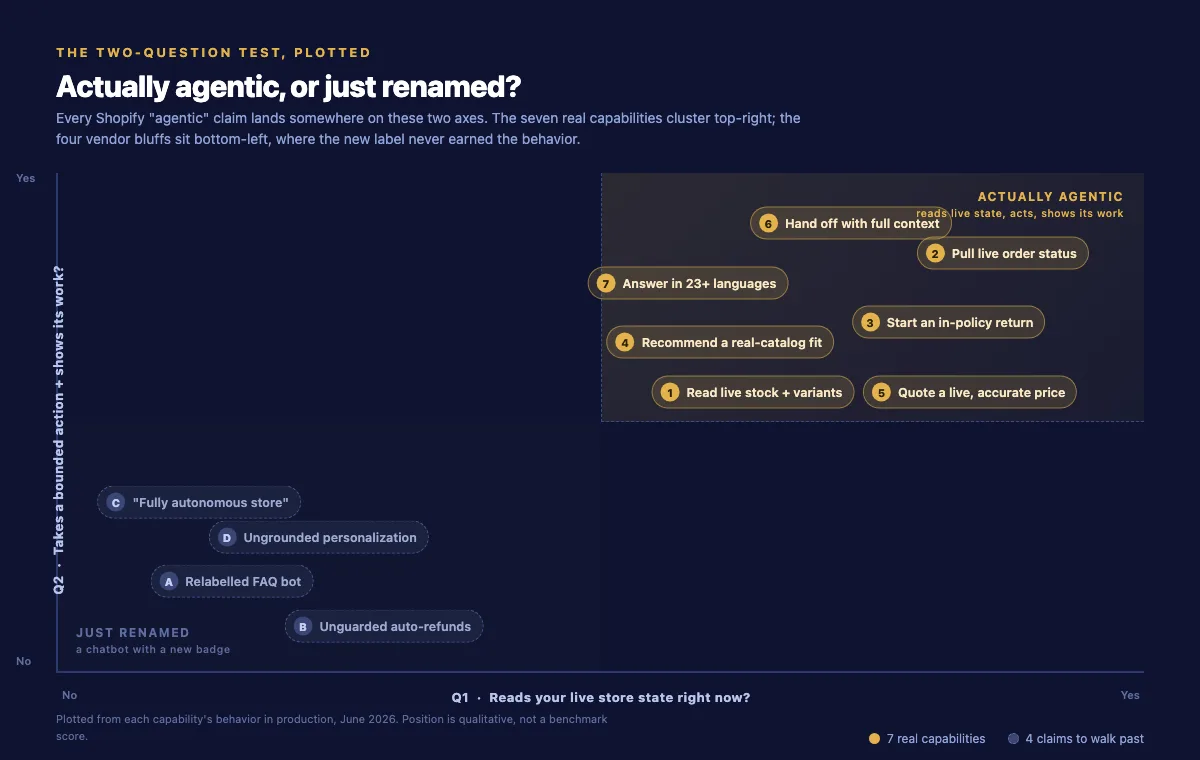
The same sort, as a table you can take to a demo: each row is a claim, and the two questions are the columns that decide where it lands.
| Claim a vendor makes | Q1: reads live store state? | Q2: bounded action, shows its work? | Verdict |
|---|---|---|---|
| Live stock and variant read | Yes | n/a (a read) | Actually agentic |
| Order status (WISMO) in chat | Yes | Yes | Actually agentic |
| Start an in-policy return | Yes | Yes | Actually agentic |
| Catalog-grounded fit advice | Yes | n/a (a read) | Actually agentic |
| Relabelled FAQ bot | No, static snapshot | No | Just renamed |
| ”Refund anything” with no checks | No verification | Unguarded, not bounded | Just renamed |
| ”Fully autonomous store” | Partial | No human-in-the-loop | Just renamed |
What can agentic AI actually do on a Shopify store in 2026?
Seven, each passing at least one half of the test against live store data. We map every one to a real merchant situation, because “it can answer questions” survives a demo and dies in production. The thread through all seven is one moat: a combined AI Search and Chatbot that learns your catalog with zero setup and reads stock, price, and order status the moment a shopper asks.
1. Read live stock and variant availability
It quotes the count that is true right now, not the one from its last sync. A shopper at IPcam-shop, a Netherlands security-camera retailer, asks whether the outdoor model is in stock in white. A live-state assistant reads the variant; a snapshot bot recites whatever was true when it last crawled. This is the fastest bluff to expose, and a clean Question 1 pass. The same read at scale is what million-product retrieval is built for.
2. Can a Shopify assistant pull live order status (WISMO) on demand?
Yes, when it is wired into Shopify Admin instead of guessing from a confirmation email. “Where is my order” is the highest-volume support question most stores get, and a real agent answers it in the chat from the order’s live fulfillment state. How the read stays scoped to the asking customer is in our order tracking and returns walkthrough . Passes both questions.
3. Start an in-policy return or exchange
A bounded action has edges, and a return is the cleanest example. The assistant checks the order against your return window, confirms eligibility, starts the exchange, then tells the shopper what it did. It does not invent a policy or refund outside the rules. That “shows its work” step is Question 2 in practice; the order tracking and returns post covers the guardrails.
4. Recommend a fit from the actual catalog, not a guess
Fit advice is only useful when it comes from products you actually stock. At Sports Basement, a shopper describing how they will use a piece of gear gets a recommendation drawn from the live catalog through semantic understanding, not keyword matching against a stale feed. That is the payoff of zero-setup learning from your catalog : the model read your real products, so it recommends real ones. Passes Question 1.
5. Quote a live, accurate price
Price is where ungrounded models quietly lie. An assistant answering from a training snapshot will happily quote last quarter’s price; one reading live store state quotes the number on the product page right now, sale included. It is the least glamorous of the seven, which is why it matters: most “agentic” demos never test it because they would fail it. Passes Question 1.
6. Hand off to a human with the full context attached
A good agent knows its edges and crosses them cleanly. When a conversation needs a person, the assistant escalates with the transcript and order context attached, so the shopper does not repeat themselves. At Puffo Sport in Italy, shoppers regularly mistake the assistant for a human, which only works when the handoff carries everything the person needs. Passes Question 2.
7. Answer in the shopper’s own language, detected automatically
23+ languages, detected from the first message, no shopper toggling a flag. Reading the incoming language is itself a Question-1 pass, and the catalog-grounded answer comes back translated rather than back-translated into something legalistic. We run this in production and wrote up what 23 languages looks like day to day , including where automatic detection earns its keep and where it strains.
Which “agentic” claims should you walk past?
Four. Each fails the test in a specific, demo-checkable way, with a tell you can catch in five minutes. The pattern across all four: the label changed, the behavior did not.
- The relabelled FAQ bot. Fails Question 1, answering from a static FAQ snapshot, never a live read. The tell: ask it your real-time stock and it deflects to “please check the product page.”
- Unguarded autonomous refunds. Fails the bounded-action clause of Question 2. Real agentic action is scoped and verified, the way the order-cancellation guardrails are built. The tell: it promises to “refund anything” with no verification step.
- The “fully autonomous store” pitch. No shipping product runs a Shopify store unattended in 2026, whatever the fully-automate-your-store results imply. The tell: no human-in-the-loop is named anywhere.
- Ungrounded personalization. Recommends from a model that never read your catalog. The tell: it suggests an out-of-stock or nonexistent SKU, because it is pattern-matching, not reading.
What the test does not catch
The two questions screen for capability, not quality. A tool can pass both and still answer badly: the test does not measure latency, accuracy under load, or how wide coverage runs before it punts to a human. It says nothing about the channel side, whether your products surface inside an external agent’s results, which the assistant-versus-chatbot breakdown takes up. What it does do is end the “is this real” argument in one demo.
Frequently asked questions
What is agentic AI in Shopify?
Agentic AI for Shopify is an assistant that reads your live store state and takes a bounded action on it, then shows its work. The test is two questions: live read now, and a scoped action it can report. Fail both and it is a relabelled chatbot.
What is the difference between an AI agent and a regular Shopify chatbot?
A chatbot answers from a static snapshot and cannot act. An agent reads live state and takes bounded actions in the conversation. The line is data access plus action, not tone. Our assistant versus chatbot guide goes deeper.
Can a Shopify chatbot process refunds or track order status?
Order status, yes, from live Shopify Admin data. Returns and refunds, yes but guardrailed and verified, never “refund anything” on request. An unverified auto-refund promise is the tell of a bluff.
Which AI agents manage post-purchase actions on Shopify?
The ones reading live order state through Shopify Admin: they track status, start in-policy returns, and hand off with context. Shoply AI runs these in the shopper chat; the order tracking and returns post shows the scoping.
Can you fully automate a Shopify store with AI in 2026?
No. Nothing runs a store unattended in 2026. What is real is bounded automation: live reads, order actions, fit recommendations, and language detection, each scoped with a human escalation path.
Does Shopify have its own AI agent?
Shopify shipped the Universal Cart Protocol and Agentic Plan for external shopping agents in 2026. That channel side is separate from the runtime assistant answering your own shoppers from live store state.
Run the test on whatever you are evaluating
Take the two questions to any vendor demo this week and watch the field narrow. Ask for a real-time stock count, then ask it to do something bounded and explain what it did. To see both pass on live store state, try the Shoply AI demo or install it from the Shopify App Store , then head to the best AI automation tools for Shopify in 2026 roundup to pick your stack. Once a tool clears both questions, enabling buy with AI on your Shopify store is the next step, the admin path plus a quick readiness audit. For the on-store side, see how to get your Shopify store mentioned in ChatGPT . Happy evaluating.