
How to Automate Your Shopify Storefront in 2026
 Frederick Casey Housand - Aug 19, 2026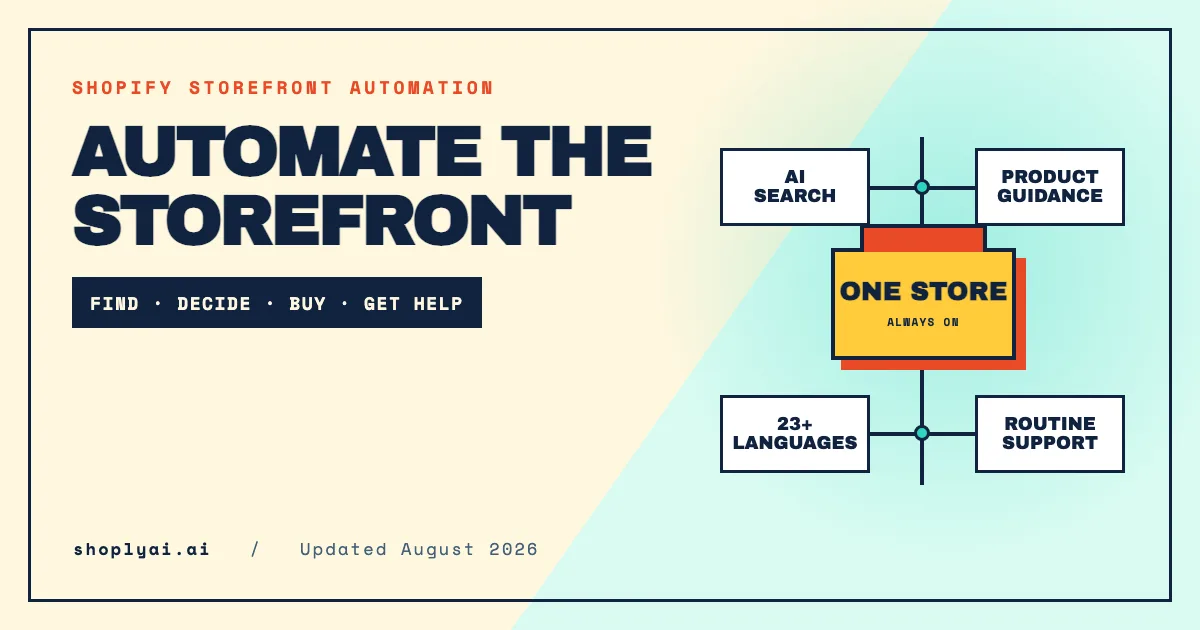
Automate your Shopify storefront across four shopper jobs: finding products, choosing the right one, getting help in their language, and answering routine questions. That turns search and chat into an always-on buying path instead of two boxes waiting for exact keywords or a support reply.
The payoff is power at the point of decision. A shopper can describe what they need, narrow the choice through conversation, and keep moving toward checkout without waiting for your team to write another rule.
What can you automate on a Shopify storefront today?
A Shopify storefront can automate the customer-facing work between arrival and checkout: natural-language discovery, conversational product guidance, multilingual help, and routine support. Shoply AI Search + Chatbot puts search and chat in one combined product, so a merchant can cover all four jobs without assembling a row of single-purpose storefront apps.
| Shopper job | What the storefront does | Shoply capability |
|---|---|---|
| Find | Understands natural-language product searches | AI Search |
| Decide | Recommends products through conversation | AI Chatbot |
| Buy | Keeps discovery and guidance connected to Shopify | Checkout integration |
| Get help | Answers routine questions across languages | Conversational support |
This is a shopper-facing layer. Marketing campaigns, inventory planning, and back-office workflows belong to a different automation category. This guide is for adding that layer. If search and chat are already installed, use the storefront optimization playbook instead.
How does natural-language discovery create a buying path?
Natural-language discovery lets shoppers search by need, use case, fit, or a mix of product details. They do not have to guess the exact words in a product title. When the first result needs more context, conversational recommendations can help them refine the choice rather than restart the search.
A shopper might type “lightweight trail shoes for wet weather” instead of a SKU or category name. AI Search handles the discovery job, while the chatbot can answer follow-up product questions. For a deeper look at those two surfaces, see AI chatbot vs AI search for Shopify.
That sequence removes two common dead ends:
- Vocabulary mismatch. Natural-language product discovery does not depend on a shopper using the same wording as the catalog.
- Choice overload. Conversational product guidance gives the shopper a way to narrow a large result set with another question.
Hand-built synonyms can patch a few known searches, but the list grows with every new product and every new way shoppers describe it. The Shopify search synonym trap shows why that maintenance job is a poor substitute for meaning-based discovery.
What changes when guidance and help speak the shopper’s language?
Multilingual storefront automation keeps product guidance and routine help available when the merchant’s team does not speak the shopper’s language. Shoply AI supports 23+ languages with automatic detection, so the conversation can start in the language the shopper is already using.
The useful part is continuity. A shopper can ask for a product, refine the recommendation, and ask a routine question without hunting for a translated FAQ or opening a separate support channel. The same storefront can serve product discovery and conversational help to a much wider audience.
Language automation is more than a translated greeting. Product names, catalog terms, and the shopper’s own phrasing all show up in the same exchange. The field notes from running 23 languages in production cover the details that matter once real shoppers start switching languages.
Routine support fits here too. Shoply’s chatbot provides conversational customer support and can learn from the store’s products, pages, and blogs. That gives shoppers a direct route to published product and policy information while your team works on questions that require individual attention. The broader support program is covered in the Shopify ticket-reduction guide.
What work does zero-setup learning remove?
Zero-setup autonomous learning removes the need to manually feed every product, page, and blog post into a separate storefront script. Shoply AI learns from product catalogs, pages, and blogs, and it supports catalogs with 1M+ products. The automation starts from the store knowledge you already maintain.
That matters because storefront upkeep expands quickly. A new collection changes what shoppers can find. A new policy page changes the answers available in chat. A new buying guide adds another source of product context. Autonomous learning lets those Shopify surfaces do more work without turning each update into a new FAQ entry or synonym rule.
The underlying catalog design still matters. Clean product information gives any search or chatbot better material to use. If you want the technical breakdown, what “AI trained on your catalog” means separates the common approaches.
How do you switch on storefront automation?
A storefront automation rollout can follow four steps: add the app, let it learn from supported store content, test the four shopper jobs, and make search and chat available on the storefront. Test the placement on your own store before you open it to every shopper.
- Add the app to Shopify. Shoply AI is Built for Shopify and supports Shopify Checkout and Shopify Admin integrations.
- Let it learn the store. Confirm that the product catalog, relevant pages, and blog content are available to the autonomous learning process.
- Run four shopper tests. Try a natural-language search, ask for a product recommendation, switch languages, and ask a routine question answered by a published page.
- Retest after store changes. Make search and chat available, then repeat the four shopper tests after catalog or store-content changes.
The turn-by-turn guide to how a Shopify AI chatbot conversation works is a useful test script for the chat side of the rollout.
Frequently asked questions
Can one Shopify app automate both search and chat? Yes. Shoply AI combines AI Search and Chatbot in one Shopify app for natural-language product discovery, recommendations, and conversational support.
Can a Shopify storefront provide multilingual help automatically? Shoply AI supports 23+ languages with automatic detection, so shoppers can begin product discovery or a support conversation in the language they are using.
How large a product catalog can Shoply AI support? Shoply AI supports catalogs with 1M+ products and learns autonomously from product catalogs, pages, and blogs.
Put your storefront to work
A storefront should do more than display products. If you want to see how natural- language search, product guidance, multilingual help, and routine support work in one buying path, explore the Shoply AI demo and the Shopify App Store listing . Use the demo to run the same four shopper tests before changing your storefront.