
AI Agents Are Shopping Your Store Right Now
 Frederick Casey Housand - Aug 6, 2026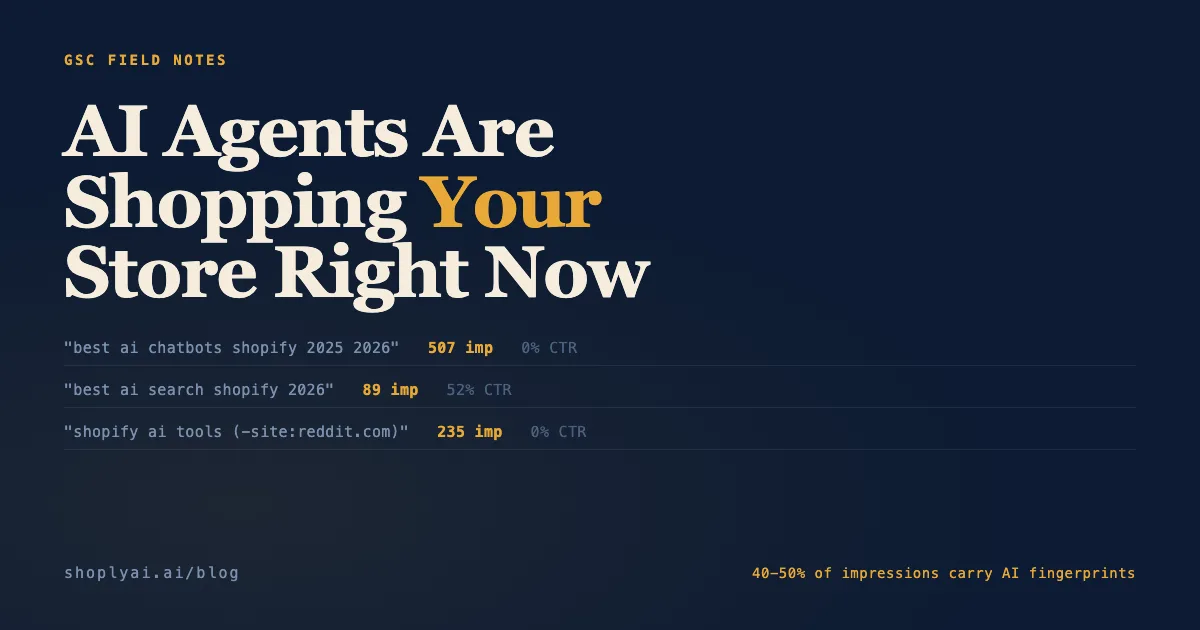
AI agents from ChatGPT, Perplexity, and Google already generate 40 to 50 percent of non-branded search impressions hitting Shopify stores, and they shop differently from every human visitor you have ever tracked.
That number came from a 28-day Google Search Console sample we ran on our own Shopify SaaS site: 364 unique queries, more than half carrying structural signatures no human types. The agents are not hypothetical. They are in your GSC right now, generating impressions you are probably misreading as organic search.
Last Tuesday morning I opened the GSC performance report for shoplyai.ai and filtered to queries containing “2025 2026.” Forty-seven rows came back. Every one was a year-stacked query, the kind where an AI agent appends two years to a search (“best ai chatbots for shopify 2025 2026”) because its prompt told it to get the freshest result. 507 impressions. Zero clicks.
I had been staring at those rows for weeks thinking they were low-quality long-tail traffic. They were AI agents reading my SERP snippets and leaving.
If you want the setup guide for making your store visible to these agents, the Buy With AI walkthrough covers that step by step. This post is about what happens after they find you: what the data looks like, what the agents actually do, and three checks you can run on your own store today.
What does AI agent traffic actually look like in Google Search Console?
Most Shopify merchants already have AI agent traffic in their GSC. They do not recognize it because the queries look like bad long-tail keywords, not like bot signatures. In a 28-day sample of 364 queries on a Shopify SaaS site, over half the non-branded impressions carried structural fingerprints that no human types: year-stacking, site-exclusion operators, and full-sentence prompts leaking from ChatGPT sessions.
We classified the queries into seven fingerprint types. Each one maps to a specific AI agent behavior.
- Year-stacking. The agent appends “2025 2026” or “2025 2026 2027” to a query. Human searchers pick one year. AI agents hedge. Example: “best ai automation tools for shopify stores 2025 2026” at 54 impressions, 0 clicks.
- Site-exclusion operators. The query contains “-site:reddit.com” or “-site:youtube.com.” That is prompt leakage from an agent told to exclude certain sources. Human searchers almost never use search operators in Google.
- Parenthetical instructions. Brackets or parentheses with meta-instructions: “(compare features and pricing)” or “(exclude free trials).” These are fragments of a ChatGPT or Perplexity prompt that leaked into the search query.
- Full natural-language prompts. Complete sentences like “which conversational search platforms work best with shopify” at 35 impressions. No human types a 9-word question into Google without abbreviating.
- Tool enumeration. Queries listing specific tools by name: “tidio vs shoply vs alhena vs ringly for shopify 2026.” A human compares two tools. An agent compares four because the prompt asked for a survey.
- Non-English on English SERPs. Queries like “meilleur chatbot ia pour boutique shopify en 2026” surfacing on English-language keyword reports. AI agents query in whatever language the user prompted them in, regardless of the target SERP locale.
- Formulaic “best X” queries. Structurally identical queries differing only by a single noun or modifier: “best ai chatbot shopify 2026,” “best ai search shopify 2026,” “best ai automation tools shopify 2026.” The consistency suggests a template, not a person.
If your store has any GSC impressions, try filtering by “2025 2026” right now. If rows come back, AI agents are already querying for your products. If you see zero impressions entirely, the troubleshooting guide covers the most common reasons stores go invisible to AI search.
Why do AI agents generate impressions but rarely click?
AI agents do not click like humans. They read your SERP snippet, extract what they need, and move on, so your impressions spike while clicks stay flat. When agents do click, they use a title-matching heuristic so precise that a single-word mismatch drops CTR from 52% to zero.
The data is stark. Year-stacking queries produced 507 impressions with 0 clicks (0.0% CTR). Formulaic single-year queries produced roughly 1,800 impressions with about 50 clicks (2.8% CTR). Meanwhile, queries we could confirm as human-originated ran between 23% and 73% CTR.
The difference between 0% and 52% CTR came down to one variable: whether the page title matched the query exactly. “Best ai search shopify 2026” clicked through to our post titled “Best AI Search for Shopify in 2026” at 52% CTR. “Best ai chatbots for shopify 2026,” with the plural “chatbots” instead of singular “chatbot,” clicked through at 0%.
A human does not care about singular versus plural. An AI shopping assistant does, because it is matching tokens, not reading meaning.
What are Shopify and the AI platforms doing about agentic commerce?
Shopify shipped three infrastructure pieces in 2026 that make every store AI-agent-accessible by default: Universal Checkout Protocol (UCP), Agentic Storefronts, and a structured Shopify Catalog API that AI agents read like a menu. If your store runs on Shopify and you have not explicitly opted out, agents from ChatGPT, Perplexity, and Google AI Mode can already browse your products, check real-time inventory, and initiate checkout.
On the platform side, ChatGPT now has native product search and purchase capabilities. Perplexity runs a shopping layer that surfaces product cards with pricing. Google’s AI Mode synthesizes product results from structured merchant data. The Reddit thread in the SERP for our primary keyword captures the developer sentiment well: Shopify is building the infrastructure, and the AI platforms are building the buyer.
For the full setup walkthrough, including how to confirm your Agentic Storefronts status in Shopify admin, see the Buy With AI setup guide. For broader strategies on getting your store found by AI platforms specifically, the ChatGPT visibility guide covers the content and structured-data side.
What should you check in your store today?
Three checks, ten minutes each. First, open your Google Search Console and filter by queries containing “2025 2026” or long natural-language questions. That is your AI agent traffic, and it is probably larger than you think. Second, compare your top-impression page titles against the exact query strings; a one-word mismatch costs you every AI-agent click. Third, confirm your Agentic Storefronts status in Shopify admin.
Check 1: Find your AI agent queries. In GSC, go to Performance, filter by query, and enter “2025 2026.” Any rows that appear are year-stacking queries from AI agents. Next try filtering for queries longer than 10 words. Humans rarely type queries that long; agents routinely do.
If you find either pattern, you already have AI agent traffic. The CTR on those rows tells you whether agents are reading your snippets (high impressions, zero clicks) or actually visiting your pages.
Check 2: Audit your title-to-query match. For every high-impression, zero-click query from Check 1, compare the query string word-for-word against the title tag of the page that appeared. If the title uses “chatbot” and the query uses “chatbots,” that mismatch alone explains the zero clicks. This is the single most effective fix we have found: matching your title to the exact query phrasing drove 52% CTR from AI agents, compared to 0% for near-matches.
Check 3: Confirm Agentic Storefronts is on. In your Shopify admin, navigate to Settings and look for the Agentic Storefronts section. Shopify enables UCP by default, so unless you or your team turned it off, your store is already visible to AI shopping agents. If you are not sure where to find it, the step-by-step setup guide walks through the exact admin path.
What happens after the agent arrives matters just as much. An AI agent can bring a shopper to your product page, but if the shopper asks a specific question and your store cannot answer in real time, that session is lost.
Shoply AI Search + Chatbot reads your entire product catalog with zero setup, handles 23+ languages in a single session, and supports catalogs of 1M+ products. The agent finds the store; the chatbot closes the sale. We have watched that pattern across 23,000 chatbot conversations, where the third-turn answer is consistently where conversion lives or dies.
Frequently asked questions
How do I know if AI agents are visiting my Shopify store? Check your Google Search Console for queries with year-stacking (e.g., “2025 2026”), site-exclusion operators (-site:reddit.com), or full-sentence questions that read like ChatGPT prompts. In a 28-day GSC sample on a Shopify SaaS site, over 50% of non-branded impressions carried these AI agent fingerprints.
Do AI agent visits count as real traffic for my Shopify store? AI agent impressions appear in Google Search Console like human impressions, but most agents extract information from your SERP snippet without clicking through. Year-stacking queries produced 507 impressions with 0 clicks in our sample. Agents that match your page title exactly click at 52% CTR, higher than most human queries.
What is Shopify Agentic Storefronts and how do I enable buy with AI? Agentic Storefronts is Shopify’s 2026 infrastructure layer that makes your store’s products, pricing, and inventory available to AI shopping agents like ChatGPT, Perplexity, and Google AI Mode. Shopify stores with Universal Checkout Protocol (UCP) are opted in by default. No additional setup is required unless you have explicitly opted out. For the full walkthrough, see our setup guide.
See it in your own data
The AI agents are already here. The question is whether your store is ready when they arrive, and whether your on-store experience can answer the shopper’s question after the agent sends them your way.
If you want to see how your product catalog looks to AI agents and shoppers, the demo store is open. The full feature breakdown is on the Shopify App Store , and the step-by-step for AI shopping conversations starts with the Buy With AI guide. Happy selling.